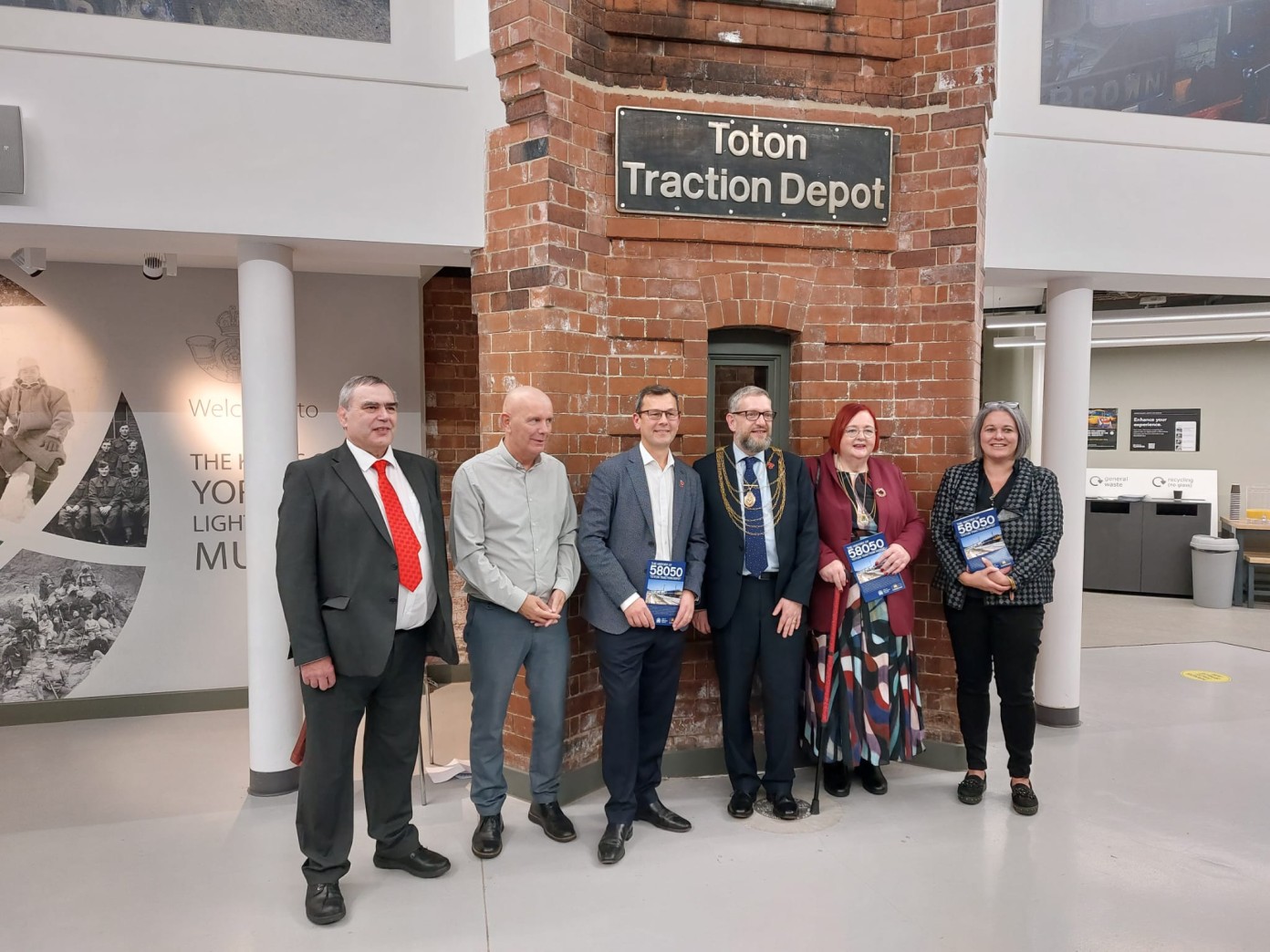
'Toton Traction Depot' nameplate unveiled at Doncaster’s Danum Museum
The nameplate was donated to the museum through an agreement with local railfreight operator DB Cargo, via an arrangement overseen by former Doncaster MP Nick Fletcher. The association between the Class 58 fleet and Doncaster is a prominent one, with the once fifty-strong fleet having been constructed at the nearby “Plant” works between 1982 and 1987.
The name *Toton Traction Depot* was bestowed on the last-built Class 58, 58050, and it is one of these original plates which now adorns the wall inside the museum.
The unveiling was undertaken by Doncaster’s Civic Mayor, Cllr Tim Needham, alongside Mr Fletcher. Also in attendance were Cllr Needham’s wife and Civic Assistant, Cllr Jane Cox, Graham Preston (DB Cargo), Nathan Turnbull (Friends of the Doncaster Museums), Ken Woods, Kevin Jagger, Thomas Wilcock, Joe Morton, Joseph Gillis, Bill McHugh (Doncaster Council), Anne-Marie Loverseed (Doncaster Council), Paul Fuller (C58LG) and Andy Patten (C58LG).
The Danum Gallery, Library and Museum is located at Waterdale, Doncaster, DN1 3BZ and is free to enter. The nameplate can be found in the railway hall, fixed to the old Doncaster High School for Girls staircase wall.


A brief history of 58050
The introduction of 58050 was a significantly important moment in the history of British Rail. It was the last diesel-electric locomotive built by British Rail Engineering Limited, and the last locomotive ever constructed at Doncaster Works, a site with over a century of locomotive-building heritage.
Early in service, the fleet struggled with rail adhesion issues caused by coal dust and slurry contamination. To address this, 58050 was fitted with an experimental system known as SEPEX — “SEParately EXcited traction motors”. Doppler radars beneath the buffers assessed rail conditions and automatically adjusted power delivery to each axle, improving traction. The system was later removed, with softer springs fitted to the centre axles to allow better rail contact.
While still trialling the SEPEX system, 58050 became the first locomotive to receive the new Trainload Coal triple-grey livery, unveiled on 15 October 1987 at Ripple Lane depot.
In 1994, it was repainted into Mainline Freight blue and silver for the Freightconnection ’94 event. Its final UK livery came in 1997 when EWS applied their maroon and gold colour scheme.
In mid-2002, the locomotive was designated for preservation by the Railway Heritage Committee, recognising its historical significance.
58050 was withdrawn in August 2002 but soon selected for use on the French hire contract. On 17 November 2004 it travelled through the Channel Tunnel into France, returning to the UK two years later. In late 2008 it was reactivated once more, this time for export to Spain where it ended its working life.
| Into UK Traffic: | 31 March 1987 |
| Stored: | 5 August 2002 |
| Exported to France: | 17 November 2004 |
| Returned to UK: | 26 October 2006 |
| Exported to Spain: | 18 September 2008 |
Toton Traction Depot
Toton sidings can trace their history back to the mid-19th century when established by the Midland Railway to handle coal traffic from the Erewash Valley collieries. As coal traffic declined, Toton evolved into a major locomotive maintenance and stabling depot. The site became the home of large fleets including Class 20s, Class 44/45 Peaks, Class 56s and the entire Class 58 fleet.
On 9 May 1987, only months after entering traffic, 58050 was formally named Toton Traction Depot by Leslie Smith, Railfreight’s National Business Manager, during a staff open day.
The name was removed in 1997 during repainting into EWS colours, before being restored on 30 August 1998 during a major open weekend at Toton. 58050 carried the name until withdrawal in 2002, when the plates were removed prior to its departure overseas.

58050’s rededication ceremony performed by (L–R): Eddie Lewis, Bryan Smith, Ian Braybrook, Andy Lickfold and Derek Howie.
(Photo: Darren Ford)

Leave Comment